exists to create art which reflects the beauty and the glory of God, to use art to comfort and encourage people, and to inspire others to pursue the arts.
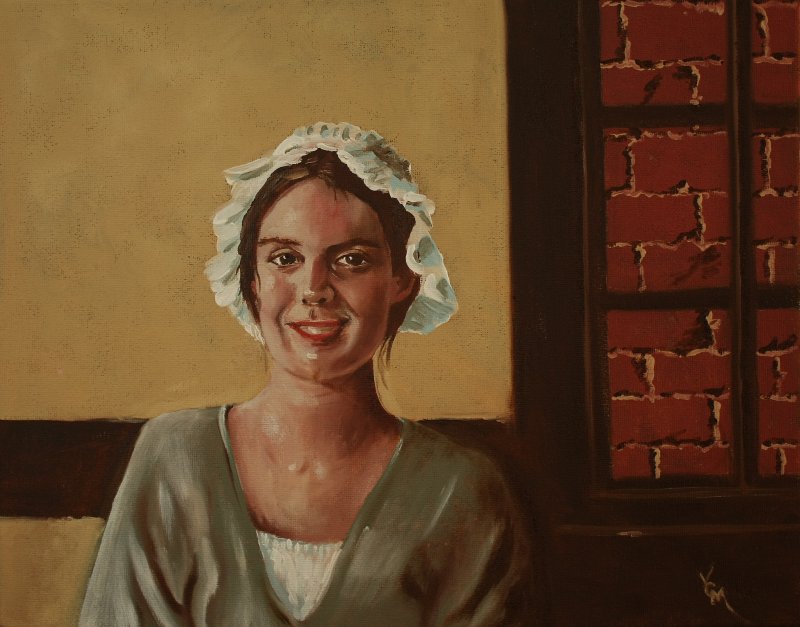
Another of David O’Dell’s great photos was the basis of this oil painting. I debated on whether or not to leave the bricks in the window or even if I should include the window. I’m glad I did. I love those bricks! LOL! Another 11×14 stretched canvas.
I have been wanting to give another reading list, but I have been reading so hard and fast that I cannot remember all the books. However, I just finished book two of Louis L’Amour’s Sackett series and I am taking a break in my reading to savor it and prepare for book three. L’Amour’s writing style in these books is so wonderful, it is like poetry. And the reader (audio book — John Curless) is so good it just adds to the poetic experience. Sigh… I hate when a good book ends…. Sometimes, when I am reading and notice the end coming, I slow down and take my time while chomping at the bit to get going. LOL! These Sackett books start in England in the late 1500’s. Barnabas Sackett goes to the New World, has adventures, and returns. In the second book, To The Far Blue Mountains, he returns to the New World and has, as his eventual goal, to get to those far blue mountains (the blue ridge). Lots of adventure!
Books, I found, had the power to make time stand still, retreat or fly into the future. — Jim Bishop
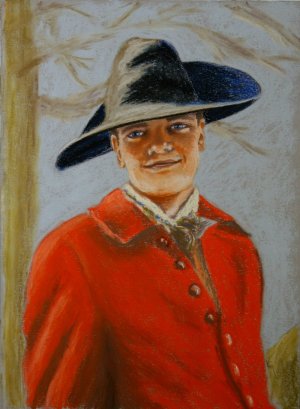
Thanks to David O’Dell, I have many photos of the people of Colonial Williamsburg with which to practice my art. This man looked very serene and content. This is 11×14 oils on canvas.
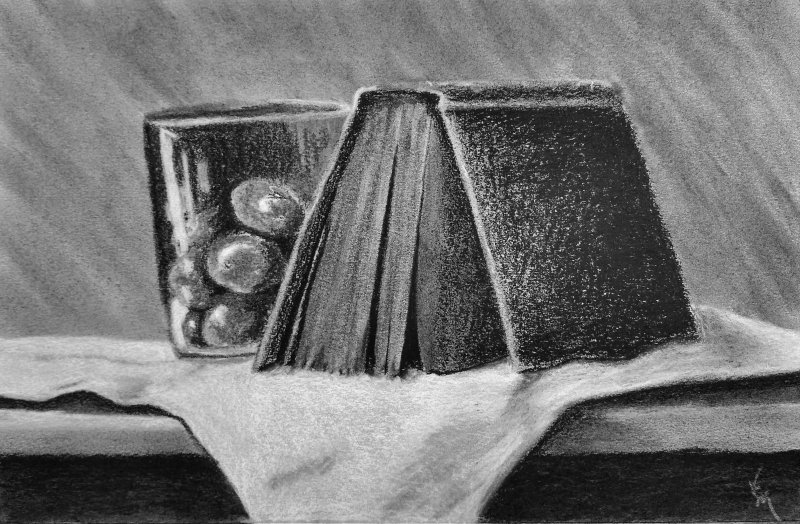
Here is a little charcoal still life that I did one morning after cleaning and re-arranging my studio/florida room. It has been too hot to work out there, so I have been painting in the living room. We have a white berber carpet and I have already had to clean up a blob of ultramarine blue paint off the carpet. Thankfully, with some solvent and clorox spray, it came up and you can’t tell where it was.
Associate with men of good quality if you esteem your own reputation; for it is better to be alone than in bad company. — George Washington
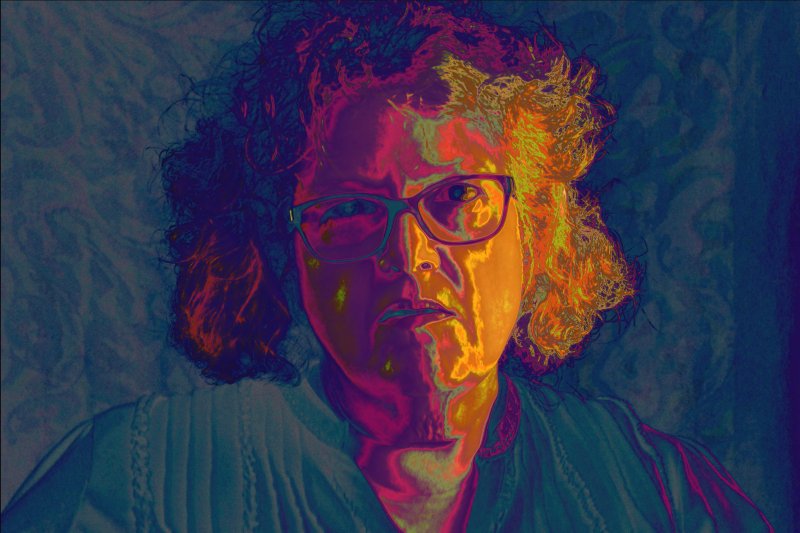
This was hard and it took me two or three weeks. I hate to say this, but I like it. LOL! It never occurred to me that I would like a portrait of myself done by Moi. The doing is hard, but the finished project is fun. I used a photo. One of these days, I will set up a mirror and try to do it like Norman Rockwell and many others have done. That should be interesting…
When having my portrait painted I don’t want justice, I want mercy. — Billy Hughes
I did a drawing of a girl looking out a window a little while back.
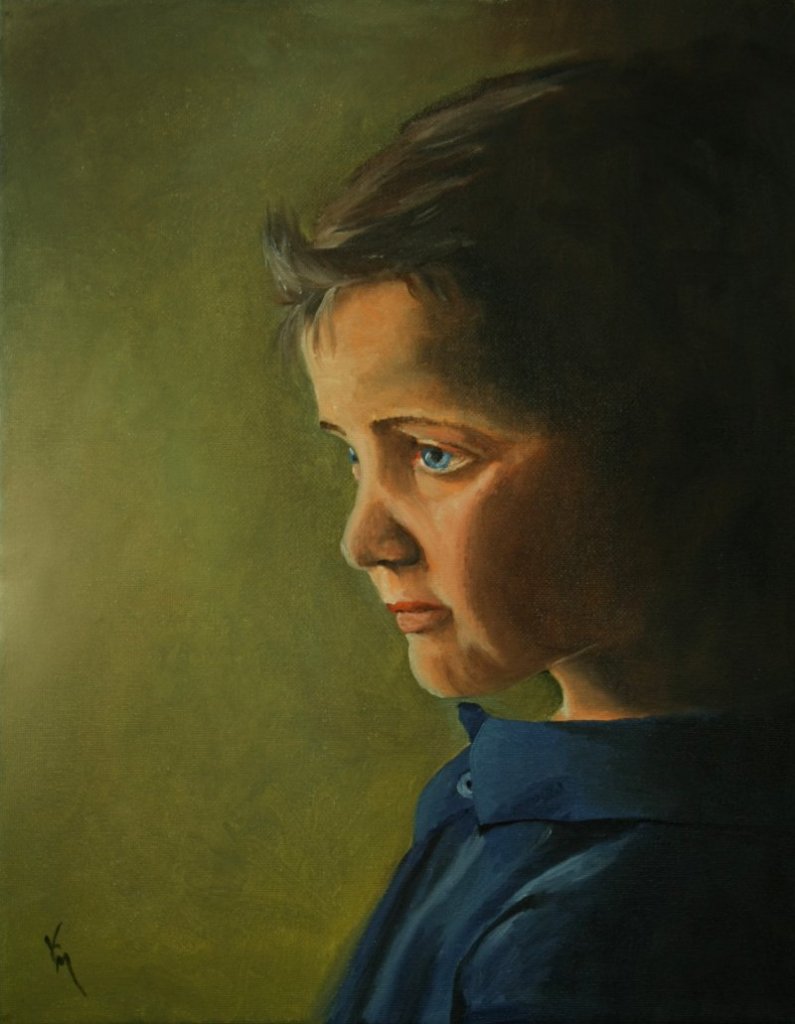
This boy looking out a window reminded me of it.
Oils on 11×14 stretched canvas.
I have often thought with wonder of the great goodness of God; and my soul has rejoiced in the contemplation of His great magnificence and mercy. May He be blessed for ever! For I see clearly that He has not omitted to reward me, even in this life, for every one of my good desires. — Saint Teresa of Avila
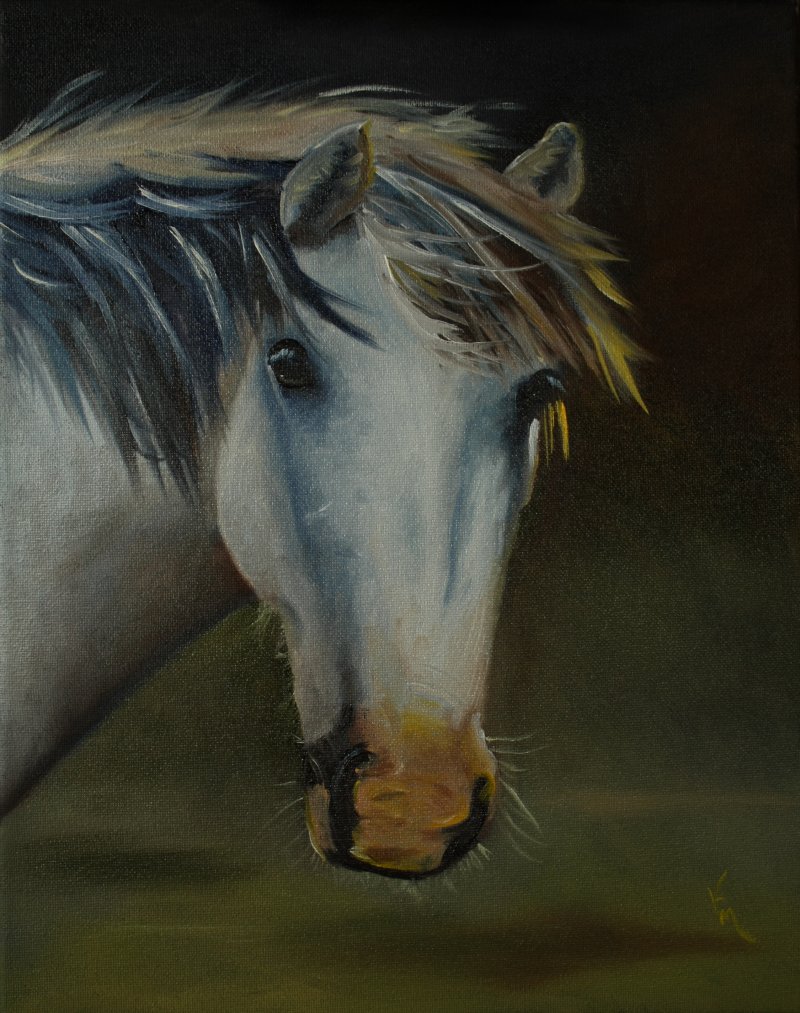
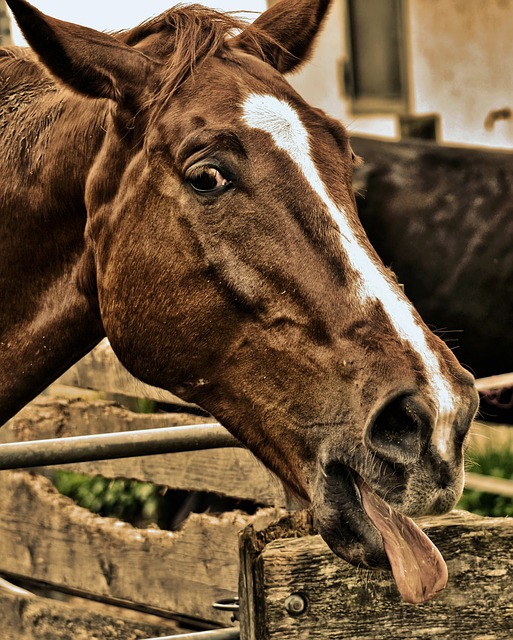
What do you call the offspring of a male aardvark and a female horse? A mule that only eats ants. My horse looks like that to me. LOL! I started out thinking that the face was too short, so I lengthened it. Then, after I was finished, I thought it looked like an aardvark! Well, other than that, I like it. I am still in training with oils, and enjoying it.
(Photo by Pixabay)
A camel is a horse designedby committee. — Alec Issigonis
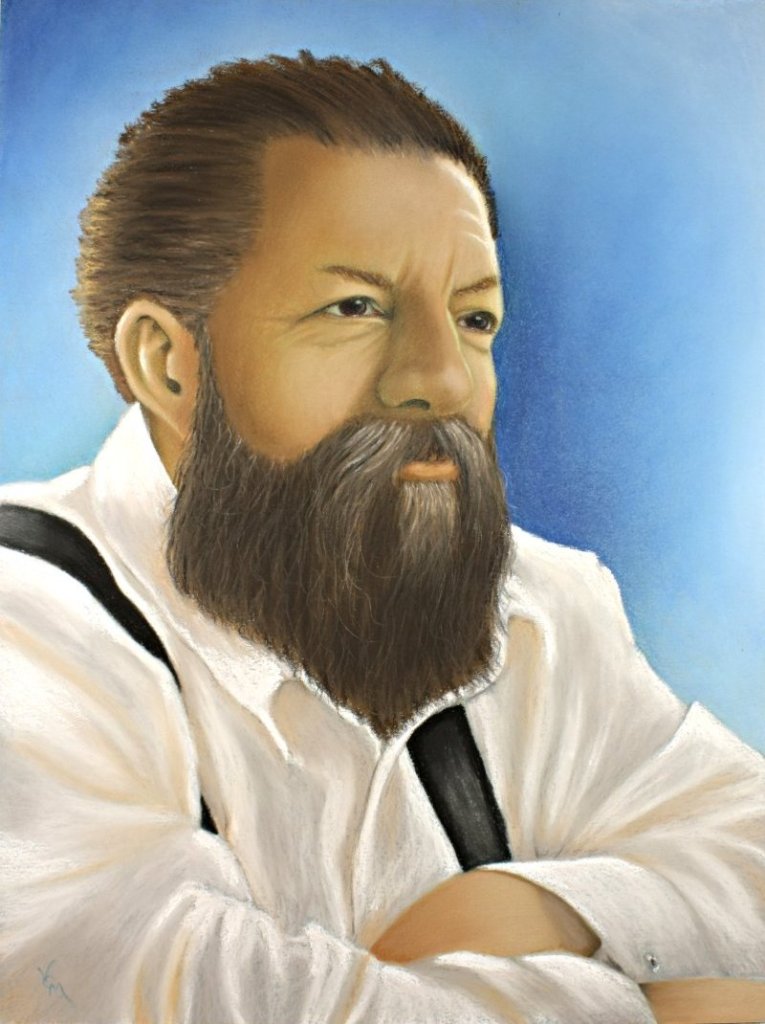
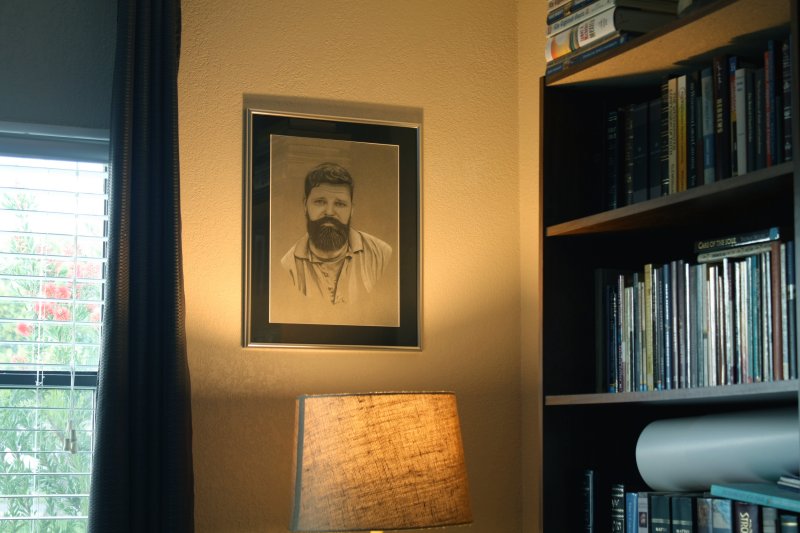
I asked Mr. Beloved if he would sit for a photo shoot for me a couple of weeks ago. He is always very willing and I really appreciate that. Here is my first painting from those photos. It was a struggle, I don’t know why. He loves it. I like it better this morning, after it has sat on the easel overnight and ripened. LOL! Before we left Ohio, Ron had lost about 90 pounds. This is his first skinny portrait. His beard is trimmed according to the Publix requirements. He looks good, I think, although I do miss the great big bushy beard.
An archaeologist is the best husband a woman can have. The older she gets the more interested he is in her. — Agatha Christie
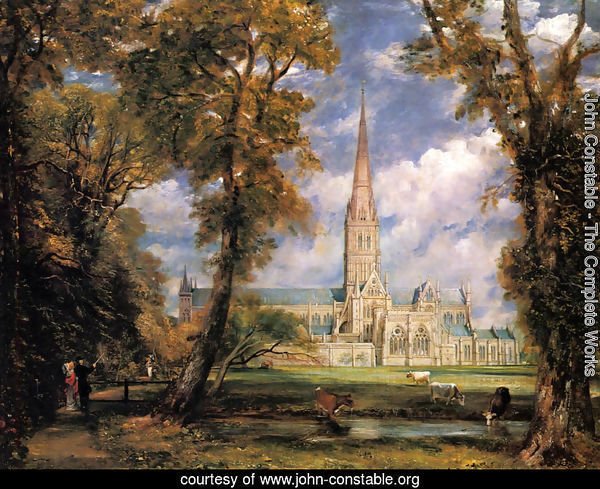
When I chose the quote, the other day, I got to thinking about John Constable. I knew of his lovely landscape paintings, but not much about him. So, I thought I would look him up and share his biography with you all.
EARLY CAREER
John Constable (11 June 1776 – 31 March 1837) was born in East Bergholt, a village on the River Stour in Suffolk, to Golding and Ann Constable. His father was a wealthy corn merchant, owner of Flatford Mill in East Bergholt and, later, Dedham Mill. Golding Constable also owned his own small ship, The Telegraph, which he moored at Mistley on the Stour estuary and used to transport corn to London. Although Constable was his parents’ second son, his older brother was mentally handicapped and so John was expected to succeed his father in the business, and after a brief period at a boarding school in Lavenham, he was enrolled in a day school in Dedham. Constable worked in the corn business after leaving school, but his younger brother Abram eventually took over the running of the mills.
In his youth, Constable embarked on amateur sketching trips in the surrounding Suffolk countryside that was to become the subject of a large proportion of his art. These scenes, in his own words, “made me a painter, and I am grateful”; “the sound of water escaping from mill dams etc., willows, old rotten planks, slimy posts, and brickwork, I love such things.” He was introduced to George Beaumont, a collector, who showed him his prized Hagar and the Angel by Claude Lorrain, which inspired Constable. Later, while visiting relatives in Middlesex, he was introduced to the professional artist John Thomas Smith, who advised him on painting but also urged him to remain in his father’s business rather than take up art professionally.
In 1799, Constable persuaded his father to let him pursue art, and Golding even granted him a small allowance. Entering the Royal Academy Schools as a probationer, he attended life classes and anatomical dissections as well as studying and copying Old Masters. Among works that particularly inspired him during this period were paintings by Thomas Gainsborough, Claude Lorrain, Peter Paul Rubens, Annibale Carracci and Jacob van Ruisdael. He also read widely among poetry and sermons, and later proved a notably articulate artist. By 1803, he was exhibiting paintings at the Royal Academy.
In 1802 he refused the position of drawing master at Great Marlow Military College, a move which Benjamin West (then master of the RA) counselled would mean the end of his career. In that year, Constable wrote a letter to John Dunthorne in which he spelled out his determination to become a professional landscape painter: “For the last two years I have been running after pictures, and seeking the truth at second hand. I have not endeavoured to represent nature with the same elevation of mind with which I set out, but have rather tried to make my performances look like the work of other men… There is room enough for a natural painter. The great vice of the present day is bravura, an attempt to do something beyond the truth.”
His early style has many of the qualities associated with his mature work, including a freshness of light, colour and touch, and reveals the compositional influence of the Old Masters he had studied, notably of Claude Lorrain. Constable’s usual subjects, scenes of ordinary daily life, were unfashionable in an age that looked for more romantic visions of wild landscapes and ruins. He did, however, make occasional trips further afield. For example, in 1803 he spent almost a month aboard the East Indiaman ship Coutts as it visited south-east coastal ports, and in 1806 he undertook a two-month tour of the Lake District. But he told his friend and biographer Charles Leslie that the solitude of the mountains oppressed his spirits; Leslie went on to write: “His nature was peculiarly social and could not feel satisfied with scenery, however grand in itself, that did not abound in human associations. He required villages, churches, farmhouses and cottages.”
In order to make ends meet, Constable took up portraiture, which he found dull work-though he executed many fine portraits. He also painted occasional religious pictures, but according to John Walker, “Constable’s incapacity as a religious painter cannot be overstated.”
Constable adopted a routine of spending the winter in London and painting at East Bergholt in the summer. And in 1811 he first visited John Fisher and his family in Salisbury, a city whose cathedral and surrounding landscape were to inspire some of his greatest paintings.
MARRIAGE AND MATURITY
From 1809 onwards, his childhood friendship with Maria Bicknell developed into a deep, mutual love. But their engagement in 1816 was opposed by Maria’s grandfather, Dr Rhudde, rector of East Bergholt, who considered the Constables his social inferiors and threatened Maria with disinheritance.
Maria’s father, Charles Bicknell, a solicitor, was reluctant to see Maria throw away this inheritance, and Maria herself pointed out that a penniless marriage would detract from any chances John had of making a career in painting.
Golding and Ann Constable, while approving the match, held out no prospect of supporting the marriage until Constable was financially secure; but they died in quick succession, and Constable inherited a fifth share in the family business.John and Maria’s marriage in October 1816 was followed by a honeymoon tour of the south coast, where the sea at Weymouth and Brighton stimulated Constable to develop new techniques of brilliant colour and vivacious brushwork. At the same time, a greater emotional range began to register in his art.
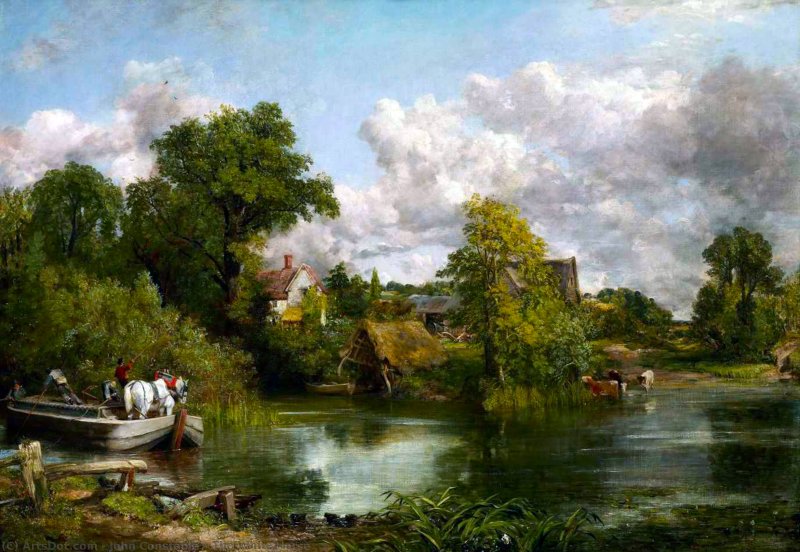
Although he had scraped an income from painting, it was not until 1819 that Constable sold his first important canvas, The White Horse, which led to a series of “six footers”, as he called his large-scale paintings.
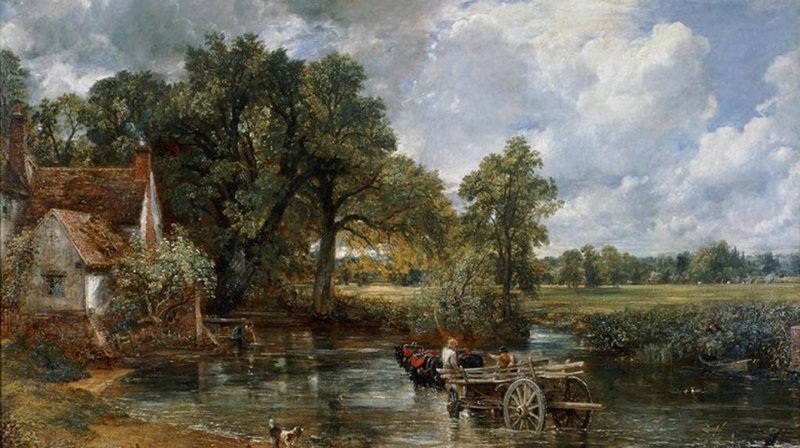
He was elected an Associate of the Royal Academy that year, and in 1821 he showed The Hay Wain (a view from Flatford Mill) at the Academy’s exhibition. Theodore Gericault saw it on a visit to London and was soon praising Constable in Paris, where a dealer, John Arrowsmith, bought four paintings, including The Hay Wain, which was exhibited at the Paris Salon of 1824, winning a gold medal.
Of Constable’s colour, Delacroix wrote in his journal: “What he says here about the green of his meadows can be applied to every tone”. Delacroix repainted the background of his 1824 Massacre de Scio after seeing the Constables at Arrowsmith’s Gallery, which he said had done him a great deal of good.
In his lifetime Constable was to sell only twenty paintings in England, but in France he sold more than twenty in just a few years. Despite this, he refused all invitations to travel internationally to promote his work, writing to Francis Darby: “I would rather be a poor man [in England] than a rich man abroad.”
In 1825, perhaps due partly to the worry of his wife’s ill-health, the uncongeniality of living in Brighton (“Piccadilly by the Seaside”), and the pressure of numerous outstanding commissions, he quarrelled with Arrowsmith and lost his French outlet.
After the birth of her seventh child in January 1828, Maria fell ill and died of tuberculosis that November at the age of forty-one. Intensely saddened, Constable wrote to his brother Golding, “hourly do I feel the loss of my departed Angel-God only knows how my children will be brought up… the face of the World is totally changed to me”.
Thereafter, he always dressed in black and was, according to Leslie, “a prey to melancholy and anxious thoughts”. He cared for his seven children alone for the rest of his life.
Shortly before her death, Maria’s father had died, leaving her pound 20,000. Constable speculated disastrously with this money, paying for the engraving of several mezzotints of some of his landscapes in preparation for a publication. He was hesitant and indecisive, nearly fell out with his engraver, and when the folios were published, could not interest enough subscribers. Constable collaborated closely with the talented mezzotinter David Lucas on some 40 prints after his landscapes, one of which went through 13 proof stages, corrected by Constable in pencil and paint. Constable said, “Lucas showed me to the public without my faults”, but the venture was not a financial success.
He was elected to the Royal Academy in February 1829, at the age of 52, and in 1831 was appointed Visitor at the Royal Academy, where he seems to have been popular with the students.
He also began to deliver public lectures on the history of landscape painting, which were attended by distinguished audiences. In a series of such lectures at the Royal Institution, Constable proposed a threefold thesis: firstly, landscape painting is scientific as well as poetic; secondly, the imagination cannot alone produce art to bear comparison with reality; and thirdly, no great painter was ever self-taught.
He also later spoke against the new Gothic Revival movement, which he considered mere “imitation”.
In 1835, his last lecture to the students of the RA, in which he praised Raphael and called the R.A. the “cradle of British art”, was “cheered most heartily”. He died on the night of the 31st March, apparently from indigestion, and was buried with Maria in the graveyard of St John-at-Hampstead, Hampstead. (His children John Charles Constable and Charles Golding Constable are also buried in this family tomb.)
I never saw an ugly thing in my life: for let the form of an object be what it may, – light, shade, and perspective will always make it beautiful. — John Constable
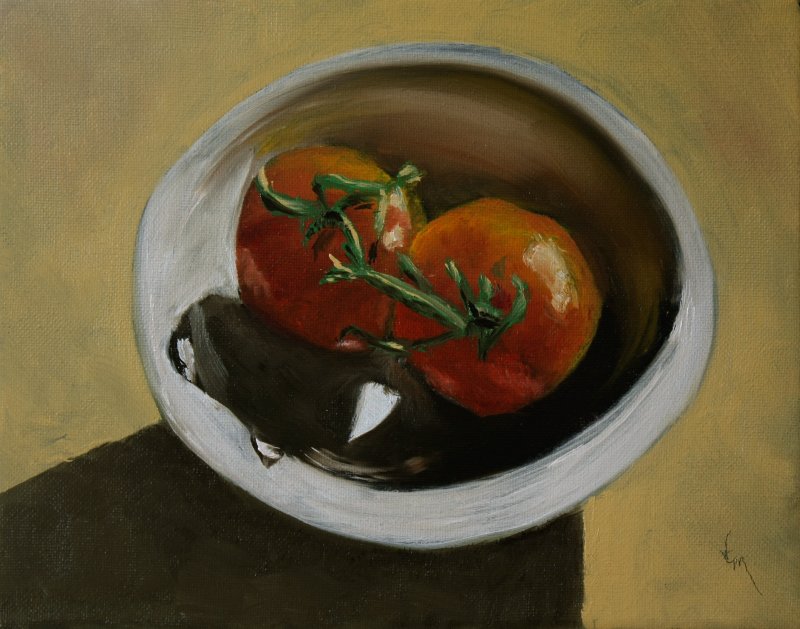
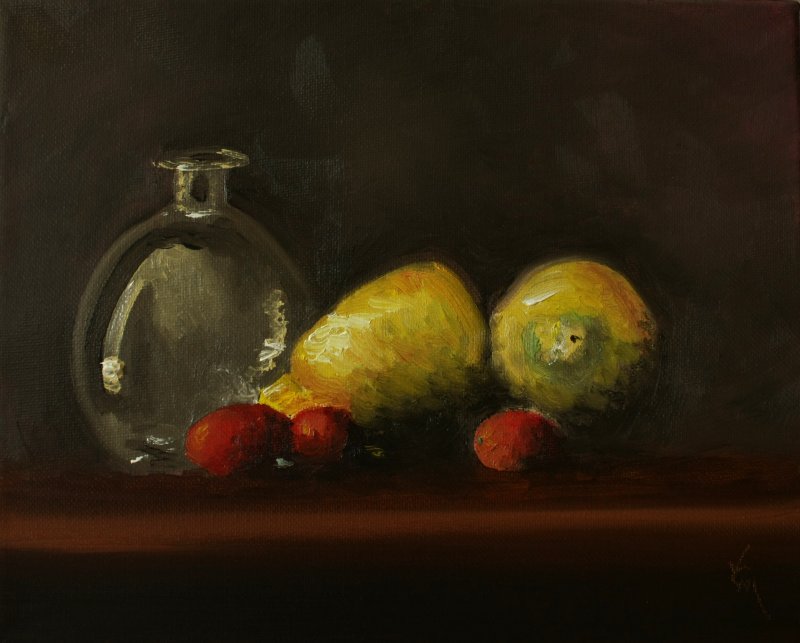
Well, here are a couple of little oil paintings to get me started, again, after so long without my oil paints. These are 8×10 on stretched canvas. These are both alla prima (all in one session, wet on wet).
Painting is another word for feeling. — John Constable
This is on the bedroom wall, between the bathroom and the closet.
Yesterday was a very stressful day. I had some very exciting reasons to get some of my pastels framed and I had to wait for some commission money so that I could begin that process. I received it and I ordered the mats to get started on the process. The delivery of the mats was very funny. They were supposed to arrive on Friday, but didn’t. They were rescheduled for Saturday, but didn’t arrive then, either. They were rescheduled for Sunday, but nothing. The tracking page was changed to say that they would be delivered on Tuesday. They got here yesterday, Monday. So, my plan had been to go get some frames on Monday, anyway. I hopped in the car and headed out. I got to the store and could not find any 16×20 frames less than $45. I know it is not all that much, but it is more than I wanted to spend on five frames. So, I waited for about 30 minutes, while another customer was being helped. I asked if there were some cheaper frames that I wasn’t seeing? I explained my situation and asked for his suggestion. He said that frames were 50% off if I had him do the work. I explained that I already had the mats. He said that is fine, he would do the work for free and I would pay for the frames and other hardware involved. Well, that sounded good to me, but I was a little hesitant. Framing pastels is a different deal than other things and I usually like to do it myself. I have been very successful in framing, thus far. But, if he could do it just for the price of the frames, etc., with my supervision, then that would work just fine. Only, I had to drive all the way home and transport five pastel paintings plus the mats back to the store.
This all started around 11:00 when I initially left the house. I went home, loaded up the artwork, which had to be transported flat on it’s back with nothing threatening it. Thankfully, we have a large backseat and a football field for a trunk. Anyway, I got them back to the store. Went back and forth six times, carrying each piece of artwork and the box of mats in the scorching heat and all the way across the store to the back corner. I was a sweaty, limping mess when it was all over. My broken foot has been bothering me for the last couple of weeks. (I broke it several years ago by dropping a large piece of firewood on it twice in 15 minutes…) Anyway, we discussed what needed to be done. After he saw what he had to work with, he had second thoughts. I should have listened to the hairs on the back of my neck which were screaming at me. But, I was already losing cognitive ability with the heat and pain and the noise and crowd of the store. He said he could do two that day, so I went to the front of the store to find a place to sit. I waited for about 30 minutes and meandered back to see how he was getting along. He looked harried and stressed.
The process that he usually used for framing was making a mess of the pastel. He showed me what he had. It was a horrible mess. Pastel dust was all over the mat and the glass. I could find no words, so I just shook my head. He said he would take it apart and try it again. I just stood there and watched him go. He did it again and it was not as much of a mess, but it was still messy. It was not his fault. It is very difficult to frame pastels, especially when it is on velour paper. And, apparently, this particular painting, Great-Grandma’s Bible, had an awful lot of pastel on it, especially the darks of the background. The poor guy was so stressed that I said that I would do the rest of them myself. And would he, please, give me the price of the frames that I would have gotten if he had done the work. He agreed. So, I had to transport all the stuff back out to the car and home. By the time, I had gotten everything back to the car and was in the car, myself, it had been six hours and I was sobbing on the phone to Ron. LOL!
The professionally framed mess and some of the ones that I did are stacked in a corner until I know what to do with them.
I spent the rest of the day and into the night doing my own framing. I got two more done that night. I got two more done this morning. And the whole time I was fighting myself about giving up on art forever! Ron talked me down off that ledge, again! But, I am moving back to oil painting. I have not done any oil painting since coming to Florida, because I don’t have a great place to spread out my stuff. But, I am going to have to use my living/dining room. So, here goes…!
I also framed my portrait of my brother, which I did many years ago, in a frame that I have had since Pat Catan’s closed in Mount Vernon. I think it looks very nice in that corner of the living room. The light has to be on to actually see it, though. LOL!
So, a question was posed, from the above portrait sitter, about how I did the background of the painting, Great-Grandma’s Bible. It looks black in the photos, but it was actually created using purple, blue, brown, and some black. He asked how it can be blended, because he thought I used pencils. I actually used soft pastels. Blending pastels is possible, but not easy, and not always effective. Usually, I just layer them until I get about where I want. That is probably why there was so much more pastel dust on that particular painting which led to the mess that it became during the great framing caper.
So, this is my initial sketch and beginning of the background.
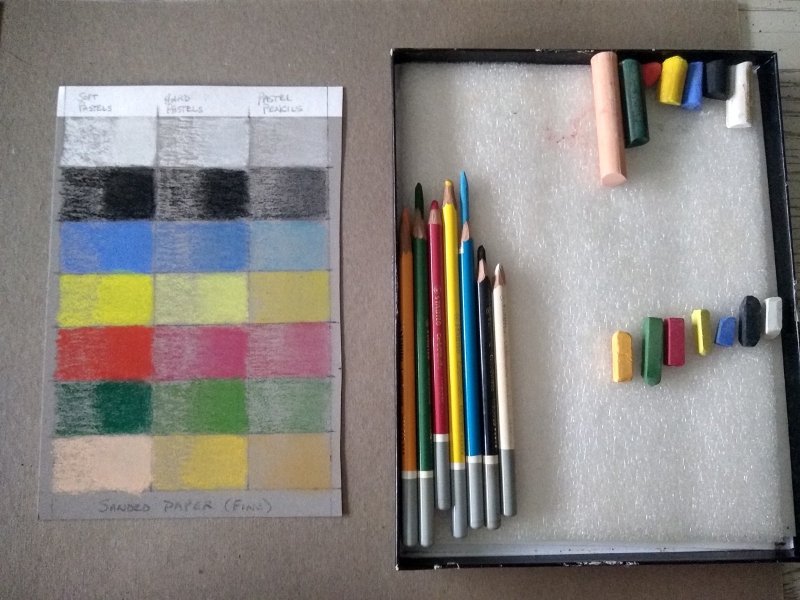
I started with purple and slowly added other colors. When you look at the painting in real life, you can see all the colors that were used. In photos, it is hard to get all the nuances of color in a work of art. The paper also has something do with how the pastels behave. I have done some examples below:
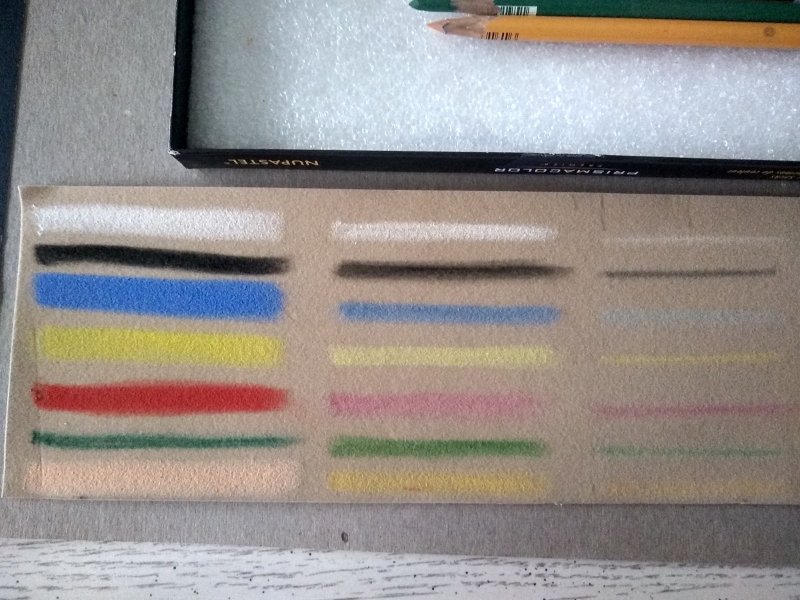
The above is finely sanded paper, which feels just like regular old sandpaper that you buy in the hardware store. You can get it in different grades. I use very fine. I like the feel of it and it holds quite a bit of pastel, but it is difficult to blend and, because of its great pastel holding ability, it uses up pastels quickly. I chose similar colors in all three pastel types to make a comparison chart.
This is Ingres paper. This is my least favorite paper. It is not cheap and I have a large pad of it. I will use it up someday, but I won’t like it. LOL! I find it next to impossible to blend it and I can’t get the texture filled in very easily. I just don’t like it. There are people who love it. I have seen a man, online, who does such beautiful pastel drawings on it, but I don’t like it. Have I told you how much I hate this paper? LOL! It is also very thin.
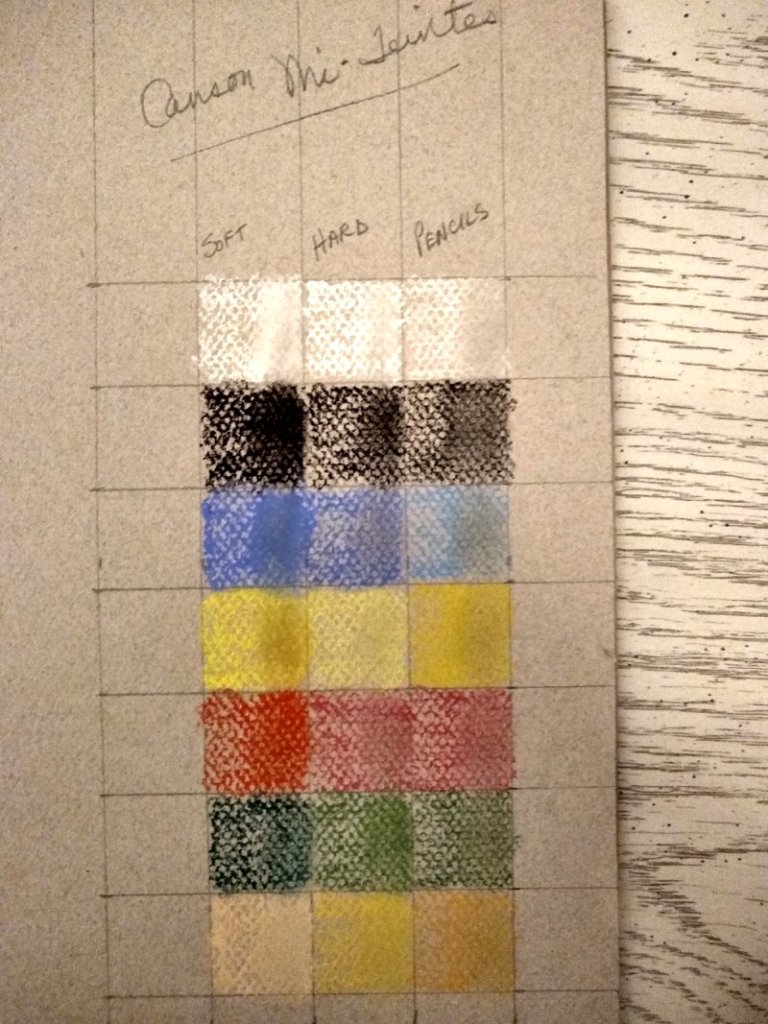
This is one of my favorite papers. It has a smooth side and a rough, patterned side. I do not like the patterned side as much as the smooth side, but it is okay. I have used both. I use this paper for graphite, quite often. I use the tinted sheets. I did use white once, but don’t remember what I used it for.
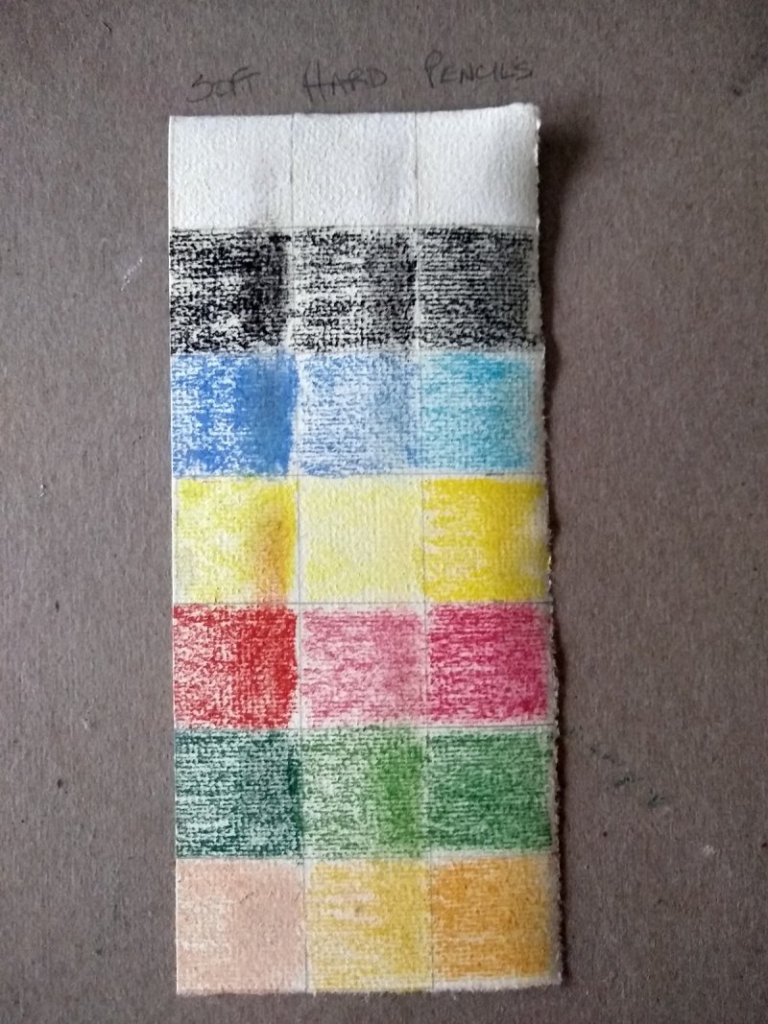
This is velour paper. It is very soft and has a nap, just like velour fabric. It is thick and floppy. It sucks up a lot of pastel and it is very difficult to get used to. I hated it when I first used it, but since I had bought some of it, I had to use it. I got used to it and then grew to love the look of it. It is still difficult to use, but you do what you have to do for the result that you want. The first column is soft pastels, the second column is hard pastels, and the third column is pastel pencils.
I don’t know about you, but I can see the obvious advantage of using the velour paper with soft pastels. Beautiful color coverage. Blending is difficult, but I use the pastel themselves for blending and it works for me. You learn how to use the pastels lightly and sparingly to get the effect you want.
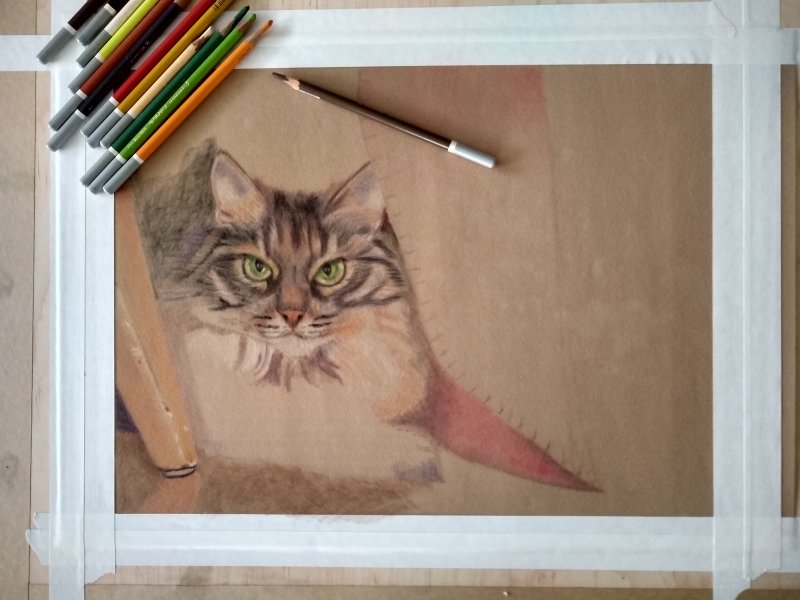
Below is a photo of the Green-Eyed Kitty when I initially started it with the pastel pencils. It did not work for me and I switched to soft pastels and, of course, you saw the result of that.
So, now I must change my mindset to work with oil paints. The rain has started. It is dark outside. My neck and back are complaining about the weather and I must think about making supper for my hard working man, who is due home soon. He is closing the store, tonight. I hope this was an interesting post.
The artist must create a spark before he can make a fire and before art is born, the artist must be ready to be consumed by the fire of his own creation. — Auguste Rodin
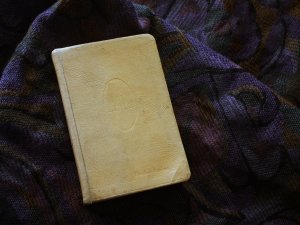
The yellow book in this picture is my great-grandma’s little bible. It is very special having bibles passed down through the family, worn with use. Last night, after it was pitch-dark, I set up and photographed several still lifes. This is soft pastels on 12×16 velour paper.
If God had intended us to follow recipes, He wouldn’t have given us grandmothers. — Linda Henley















 Virginia C. McCoy Fine Art
You must be logged in to post a comment.